When the Shrinking Cities show opened at MOCAD a few years back, there was a great creative/academic series of responses to the propositions the projects posed. Last week, a larger debate was fueled by remarks made by Detroit Mayor Dave Bing that acknowledges the challenges posed by shrinking population and the costs of maintaining infrastructure and services.
"We're not going in and just taking people's property and saying you don't have any say," Bing said. "Those people that we can encourage and that they would agree to be moved, those are the ones that we are going to work with first."
Last week I read this to a group of 12 year olds near Downtown. The first pause was that several of them did not know who Dave Bing was. The second pause came when they realized that the areas he was talking about are where their homes are.
Some excerpts from the article I read them from The Detroit News. on March 9:
The most viable neighborhoods, with the fewest vacant lots, are on the fringes, near the suburbs. The ones with the most abandoned houses and vacancies are closest to downtown.
"We have a downtown core and then we clearly have an outer ring," said Douglass Diggs, interim executive director of the recently formed Detroit Land Bank, a primary agency in the city's downsizing push. "The question is how do you link those two?
"Looking at the maps it seems like the real challenge is what to do with the middle part."
Some of the uses for the middle part, the neighborhoods like the former Paradise Valley, include farmland. "What?!!" asked the kids in my group. "First of all, we don't grow vegetables.
link to The Detroit News article
March 23 Mayor Bing makes his State of the City address--watch for updates,
Showing posts with label Research. Show all posts
Showing posts with label Research. Show all posts
Saturday, March 13, 2010

Saturday, December 19, 2009
Design 99's Neighborhood Project
Starting yesterday, Design 99 took up residence in the Gibbs Gallery at the Detroit Institute of Arts developing The Neighborhood Project.

1.
It's a work-in-progress workshop where until 20 March the Power House neighborhood will interact with the museum visitors.

2.

3.

4.

5.

6.

1.
It's a work-in-progress workshop where until 20 March the Power House neighborhood will interact with the museum visitors.

2.

3.

4.

5.

6.
Wednesday, December 16, 2009
Power House Close-Up
The Power House is off the grid. Since the summer a wind mill on its roof and two solar panels are keeping the battery filled up. After their show in the Detroit Art Institute Design 99's Mitch and Gina plan to continue with the transformation of the house.

1. The Power House, view from Moran Street - you can see the windmill on the roof

2. The veranda

3. The backyard

4. The backyard, view from the back alley

5. View from the veranda into the former living room, future gallery room

6. The former kitchen

7. The former kitchen from the opposite angle

8. View up from the Basement

9. Room next to the gallery space

10. Back room, behind the former kitchen

11. The attic

12. The electricity system connecting the wind mill and solar panels to the battery

13. Looking into the second room from above

14. Floor detail

The back alley behind the Power House
Sunday, September 20, 2009
Detroit wood in Holland

1. Wood on the veranda in Klinger
The Detroit wood is safe in Holland! After another few days of extensive salvaging (shown below in the Lee Plaza Hotel, a hotel considered one of the best in Detroit in the twenties - ´Art Deco with a Mediterranean twist- ) artist Diederick Kraaijeveld had gathered a nice base for his Icons of Hope. Almost all planks fitted in the Army Surplus bags. Fortunately the neighbors at Klinger Street were willing to lend their scales, so both bags could be filled until they both weighed the maximum allowed weight of 20 kilograms (or 45 American pounds). The coming months will be used to build the pieces. This weblog will keep you posted on that.....

2. Lee Plaza Hotel

3. Lee Plaza Hotel

4. Lee Plaza Hotel

5. Kraaijeveld with the Army Surplus bags
Thursday, September 17, 2009
Detroit wood for Icons of Hope
Great hunting grounds for Diederick Kraaijeveld in Detroit. With urban explorer and guide Dan and Dutch cameraman Gideon Elings he was able to salvage beautiful pieces of wood for his 'Icons of Hope'.

1. Kraaijeveld in action
Kraaijeveld builds pieces out of originally colored found wood. 'An abandoned fire station proved very resourceful', Kraaijeveld tells us, ' I found nice red painted planks there'. Even the Packard Car plant, that has been abandoned since the sixties, offered real interesting pieces of wood: the floors are covered in oak: the cars used to be driven over it IN the plant. ' And the administrative offices all had oak panelling. Most of it is still there', Kraaijeveld explains. 'Not all......., I took a few pieces'.

2. Courtroom Highland Park

3. Floor Packard Car plant

4. Police Office Highland Park
Friday is the last day of wood salvaging for Kraaijeveld, then the next quest is how to get it shipped to the Netherlands.
Tuesday, June 23, 2009
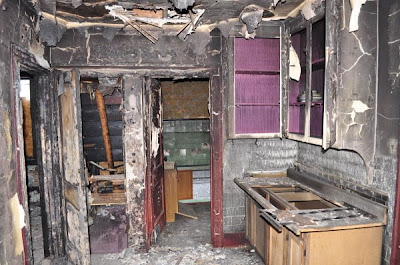
13015 Klinger follow up
A breakdown of the initial costs to get things under way and secure/prepare the house:
Purchase Price: $1.00
2008 Taxes: $1,571.12
Interior Demo (includes Dumpster rental/labor): $1,500
Lighting (solar) Interior/exterior: $300
New Lock: $60
total: $3432.12




[Photos by Mitch Cope]
Purchase Price: $1.00
2008 Taxes: $1,571.12
Interior Demo (includes Dumpster rental/labor): $1,500
Lighting (solar) Interior/exterior: $300
New Lock: $60
total: $3432.12


[Photos by Mitch Cope]
Thursday, May 28, 2009
A coop for 13015 Klinger
Mitch Cope recently signed a purchase agreement for the home 13015 Klinger. There was fire damage in the interior, some extensive floor damage, however not unfixable.
Together with Mitch, Toby Barlow and Kerstin Niemann, we're currently setting up a coop for the house based on bylaws inspired by Lafayette Park and Dutch Housing coorporation Ymere.
The ambition to use the house, amongst others, as a residency.


Photos by Mitch Cope
Together with Mitch, Toby Barlow and Kerstin Niemann, we're currently setting up a coop for the house based on bylaws inspired by Lafayette Park and Dutch Housing coorporation Ymere.
The ambition to use the house, amongst others, as a residency.


Photos by Mitch Cope
Saturday, May 2, 2009
Property Sold!
Unfortunately, the bank did not accept our offer. Instead they accepted another offer on this property.


Sunday, April 19, 2009


Subscribe to:
Posts (Atom)


