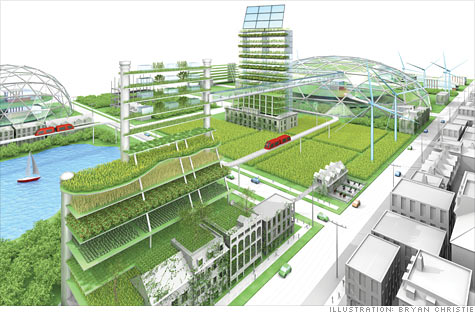
An excellent piece in Guernica on ruin porn, Detroitsploitation and three classic Detroit narratives: Detroit as metonym, the Detroit lament, and Detroit utopia.
Sunday, January 23, 2011
Detroitism
An excellent piece in Guernica on ruin porn, Detroitsploitation and three classic Detroit narratives: Detroit as metonym, the Detroit lament, and Detroit utopia.
Labels:
aesthetic consumption,
Press,
representation,
ruin porn
Friday, November 19, 2010
Thursday, November 11, 2010
2012 redesigns Power House roof

2012 architects redesigned in collaboration with Design 99 the roof of the Power House.
2012 has been in the first resident in the residency pilot-project, which Partizan Publik is curating in collaboration with Design 99 and is supported financially by Fund BKVB.
Currently Erik Jutten is working on behalf of 2012 on the reconstruction of the roof with Mitch Cope en Gina Reichert. Early 2011 designer Guido Marsille will take over Erik's position.
Tuesday, May 25, 2010
Too Much of a Good Thing
OPENING THIS THURSDAY
(that's right, Thursday)
May 27th at MOCAD
Public opening 8 – 11PM, $6

FEATURING
The Neighborhood Machine
A mobile device that roams and wonders one Detroit neighborhood in search of evidence of what is believed to be a vast reservoir of spiritual, physical and emotional wealth waiting to be found in the back alleys, dark side streets, and abandoned backyards of the neighborhood.
The Machine will be capable of physically altering in major ways the landscape and built environment in order to find these resources. It will also act as a communicator and distributor of information, collecting never before seen images and video of these mysterious resources. While roaming the machine lays tracks that can be followed by others for reconstruction and reorganization in order to bring in the future neighborhood.
"Design 99’s work explores the edges of art practice, utilizing, design, architecture, found materials and utilitarian objects to propose creative solutions to complex problems. Their practice has at its core the belief that transformation can happen in a natural way, if we only take a look, think out-of-the-box and take action."
Too Much of a Good Thing is organized by the Museum of Contemporary Art Detroit and curated by Luis Croquer, Director and Chief Curator.
Show runs through July 25th
Museum hours: Wednesday – Sunday, 11 – 5PM, – 8PM on Thursday & Friday
MOCAD is located at 4454 Woodward Ave, 3 blocks south of Warren, in Detroit
(that's right, Thursday)
May 27th at MOCAD
Public opening 8 – 11PM, $6

FEATURING
The Neighborhood Machine
A mobile device that roams and wonders one Detroit neighborhood in search of evidence of what is believed to be a vast reservoir of spiritual, physical and emotional wealth waiting to be found in the back alleys, dark side streets, and abandoned backyards of the neighborhood.
The Machine will be capable of physically altering in major ways the landscape and built environment in order to find these resources. It will also act as a communicator and distributor of information, collecting never before seen images and video of these mysterious resources. While roaming the machine lays tracks that can be followed by others for reconstruction and reorganization in order to bring in the future neighborhood.
"Design 99’s work explores the edges of art practice, utilizing, design, architecture, found materials and utilitarian objects to propose creative solutions to complex problems. Their practice has at its core the belief that transformation can happen in a natural way, if we only take a look, think out-of-the-box and take action."
Too Much of a Good Thing is organized by the Museum of Contemporary Art Detroit and curated by Luis Croquer, Director and Chief Curator.
Show runs through July 25th
Museum hours: Wednesday – Sunday, 11 – 5PM, – 8PM on Thursday & Friday
MOCAD is located at 4454 Woodward Ave, 3 blocks south of Warren, in Detroit
Tuesday, May 18, 2010
Whose Banksy is it?
I've strolled through and around the former Packard Plant for several years. Met scrap traders and trash dumpers, explorers, tourists, gangs of people, gangs of dogs, seen great painted walls and lots of semi-poetic urban scrawls ("What happened to the American Dream? is the one I see by the Grand Boulevard side.) The former plant is close to a mile long--it's easy not to see everything. But keen eyes spotted a wall painting by elusive street artist Banksy--and took it (the movers are part of Detroit gallery/collective 555.) This is either in the great Detroit scrap tradition (finders keepers even if it is on private property) or its a chapter for city lore.
Here are some questions this (re)moval is provoking for me: What is street art removed from the street? Can you move it like a painting on a wall without changing the meaning of the work or the act? Is the move its own act?
Detroit Free Press on Banksy's move
Here are some questions this (re)moval is provoking for me: What is street art removed from the street? Can you move it like a painting on a wall without changing the meaning of the work or the act? Is the move its own act?
Detroit Free Press on Banksy's move
Friday, April 30, 2010
Dateline Detroit
Dateline Detroit
Last week, NBC broadcast an episode of its Dateline news program on Detroit. The primary focus is familiar--the vulnerable, poor yet resilient African American residents of a crumbling city with a sprinkling of artists and celebrities.
Dateline host Chris Hansen speaks with and profiles, among others, Mitch Cope and Gina Reichert, Kid Rock and Raccoon Man, Glemmie Beasley, a blues musician who shoots and eats raccoon around the city for sale and nutritional value. The local and national response is that Detroit, like Baltimore and other African American inner cities is thick in media sensations like Raccoon Man and that in an hour long special, a broader view is not only possible, but a responsibility.
Some local news responses to the special:
Detroit News on Dateline
Last week, NBC broadcast an episode of its Dateline news program on Detroit. The primary focus is familiar--the vulnerable, poor yet resilient African American residents of a crumbling city with a sprinkling of artists and celebrities.
Dateline host Chris Hansen speaks with and profiles, among others, Mitch Cope and Gina Reichert, Kid Rock and Raccoon Man, Glemmie Beasley, a blues musician who shoots and eats raccoon around the city for sale and nutritional value. The local and national response is that Detroit, like Baltimore and other African American inner cities is thick in media sensations like Raccoon Man and that in an hour long special, a broader view is not only possible, but a responsibility.
Some local news responses to the special:
Detroit News on Dateline
Saturday, March 13, 2010
Detroit Mayor Bing's Plans to Downsize the City
When the Shrinking Cities show opened at MOCAD a few years back, there was a great creative/academic series of responses to the propositions the projects posed. Last week, a larger debate was fueled by remarks made by Detroit Mayor Dave Bing that acknowledges the challenges posed by shrinking population and the costs of maintaining infrastructure and services.
"We're not going in and just taking people's property and saying you don't have any say," Bing said. "Those people that we can encourage and that they would agree to be moved, those are the ones that we are going to work with first."
Last week I read this to a group of 12 year olds near Downtown. The first pause was that several of them did not know who Dave Bing was. The second pause came when they realized that the areas he was talking about are where their homes are.
Some excerpts from the article I read them from The Detroit News. on March 9:
The most viable neighborhoods, with the fewest vacant lots, are on the fringes, near the suburbs. The ones with the most abandoned houses and vacancies are closest to downtown.
"We have a downtown core and then we clearly have an outer ring," said Douglass Diggs, interim executive director of the recently formed Detroit Land Bank, a primary agency in the city's downsizing push. "The question is how do you link those two?
"Looking at the maps it seems like the real challenge is what to do with the middle part."
Some of the uses for the middle part, the neighborhoods like the former Paradise Valley, include farmland. "What?!!" asked the kids in my group. "First of all, we don't grow vegetables.
link to The Detroit News article
March 23 Mayor Bing makes his State of the City address--watch for updates,
"We're not going in and just taking people's property and saying you don't have any say," Bing said. "Those people that we can encourage and that they would agree to be moved, those are the ones that we are going to work with first."
Last week I read this to a group of 12 year olds near Downtown. The first pause was that several of them did not know who Dave Bing was. The second pause came when they realized that the areas he was talking about are where their homes are.
Some excerpts from the article I read them from The Detroit News. on March 9:
The most viable neighborhoods, with the fewest vacant lots, are on the fringes, near the suburbs. The ones with the most abandoned houses and vacancies are closest to downtown.
"We have a downtown core and then we clearly have an outer ring," said Douglass Diggs, interim executive director of the recently formed Detroit Land Bank, a primary agency in the city's downsizing push. "The question is how do you link those two?
"Looking at the maps it seems like the real challenge is what to do with the middle part."
Some of the uses for the middle part, the neighborhoods like the former Paradise Valley, include farmland. "What?!!" asked the kids in my group. "First of all, we don't grow vegetables.
link to The Detroit News article
March 23 Mayor Bing makes his State of the City address--watch for updates,
Friday, March 12, 2010
Toothless and Incoherent
More Detroit in the Guardian (you'd think there wasn't enough urban misery happening this side of the Atlantic). This time it's a plug for Julian Temple's new documentary Requiem for Detroit of which I saw a work-in-progress version at the IDFA end of last year. What I saw then annoyed me... for a start there was an overabundance of white men talking, and the first black face on the screen was toothless and incoherent - and this is in a city where officially over 80% of the inhabitants are African American - and the rest of the film continued to designate the job of telling the story of the city to the white minority, though Tyree Gruyton gets to say something and Grace Lee Boggs put in an eloquent appearance near the end of the film. What was also interesting was the way in which - other than the Ford manager - every single white person is filmed in their cars, a kind of cinematic white exodus of the city, whereas all the African Americans were, without exception, intransient, 'left behind' - which I thought was a rather clever device but on talking to the producer after the screening I got the impression that this wasn't a deliberate (di)vision. I also found the music in the section on the riots rather disturbing - 'Dancin' in the Streets' may well have been the anthem of the rioters and would have been fine accompaniment to a bit of burning and stone throwing, but it seemed to me inappropriate to run it whilst the bloodied bodies of protesters were being carried off - came across more like Dancin' on their Graves...
The film's showing on BBC-2 tomorrow evening at 22u (Dutch time) and I'm curious to see if anything got done with my criticism of the underlying racism in the way the population was being portrayed.
Tuesday, March 9, 2010
FWD: Detroit wants to save itself by Shrinking
Some quotes from the AP piece, published on Yahoo News March 8 2010:
"Detroit, the very symbol of American industrial might for most of the 20th century, is drawing up a radical renewal plan that calls for turning large swaths of this now-blighted, rusted-out city back into the fields and farmland that existed before the automobile."
"Near downtown, fruit trees and vegetable farms would replace neighborhoods that are an eerie landscape of empty buildings and vacant lots. Suburban commuters heading into the city center might pass through what looks like the countryside to get there. Surviving neighborhoods in the birthplace of the auto industry would become pockets in expanses of green."
"Mayor Dave Bing, who took office last year, is expected to unveil some details in his state-of-the-city address this month."
read more here
"Detroit, the very symbol of American industrial might for most of the 20th century, is drawing up a radical renewal plan that calls for turning large swaths of this now-blighted, rusted-out city back into the fields and farmland that existed before the automobile."
"Near downtown, fruit trees and vegetable farms would replace neighborhoods that are an eerie landscape of empty buildings and vacant lots. Suburban commuters heading into the city center might pass through what looks like the countryside to get there. Surviving neighborhoods in the birthplace of the auto industry would become pockets in expanses of green."
"Mayor Dave Bing, who took office last year, is expected to unveil some details in his state-of-the-city address this month."
read more here
Wednesday, March 3, 2010
Jon Brumit in the Guardian
Article in today's Guardian with our friend Jon Brumit - all old news, but I'm surprised to hear that only one in five houses is empty, I thought it only one in five lived in...
Click here for the article.
Thursday, February 25, 2010
ReadyMade's Hands Up For Detroit
ReadyMade Magazine visited Detroit and published a photo series of the works of artists Jimini Hignett, Tyree Guyton, Mitch Cope & Gina Reichert and Gregory Holm & Matthew Radune on its blog. The commentary on the trip starts with a comparison of these works and French high-wire artist Philippe Petit walk between the unfinished twin towers of the World Trade Center in New York in 1974.

[Image taken from ReadyMade blog]
The writer of the blog post - ReadyMade editor-in-chief Andrew Wagner - comments: 'Obviously it was an incredible physical undertaking and an adventure unlike any other. More than that though, I was taken with the fact that Petit took this amazing risk for seemingly no other reason other than to see if it could be done. To see what is possible. To see what would happen. Much like Petit’s walk atop New York, the city of Detroit sparks similar emotions in me.'
Wagners proves himself a Detroit optimist as he ends his story saying: 'I believe the next few years will see a true renewal in the city. And not in any contrived, idealistic, New Urbanist manner, but rather in a real, meaningful way that will help guide cities of all shapes and sizes in the years to come.'
ReadyMade is inspired by Detroit and its many opportunities to open up windows for different kinds of urban development, which is great. From my own perspective, that of European out-of-towner, I tend to believe that the more people write and think enthusiastic about Detroit the greater the chance that good things might happen to the city.
Yet, Wagner’s interesting comparison between the work by Petit in New York in 1974 and the four very different contemporary projects in Detroit inspired me to raise a few question concerning the role of these types of art projects in the post-industrial place as Detroit.
Who is performing what and to which audience? What is the public? What is the community of these projects?
I could be wrong but I have the impression there are important distinctions between the works Wagner encountered during his city tour. Although they might altogether – edited in a photo series like the one on the ReadyMade blog – add to an optimistic imagery of Detroit, the differences of these projects in terms of production process or in regards of the audiences the artists intended to perform for might be a factor in determining the type of renewal that Detroit will see.
[Image taken from ReadyMade blog]
The writer of the blog post - ReadyMade editor-in-chief Andrew Wagner - comments: 'Obviously it was an incredible physical undertaking and an adventure unlike any other. More than that though, I was taken with the fact that Petit took this amazing risk for seemingly no other reason other than to see if it could be done. To see what is possible. To see what would happen. Much like Petit’s walk atop New York, the city of Detroit sparks similar emotions in me.'
Wagners proves himself a Detroit optimist as he ends his story saying: 'I believe the next few years will see a true renewal in the city. And not in any contrived, idealistic, New Urbanist manner, but rather in a real, meaningful way that will help guide cities of all shapes and sizes in the years to come.'
ReadyMade is inspired by Detroit and its many opportunities to open up windows for different kinds of urban development, which is great. From my own perspective, that of European out-of-towner, I tend to believe that the more people write and think enthusiastic about Detroit the greater the chance that good things might happen to the city.
Yet, Wagner’s interesting comparison between the work by Petit in New York in 1974 and the four very different contemporary projects in Detroit inspired me to raise a few question concerning the role of these types of art projects in the post-industrial place as Detroit.
Who is performing what and to which audience? What is the public? What is the community of these projects?
I could be wrong but I have the impression there are important distinctions between the works Wagner encountered during his city tour. Although they might altogether – edited in a photo series like the one on the ReadyMade blog – add to an optimistic imagery of Detroit, the differences of these projects in terms of production process or in regards of the audiences the artists intended to perform for might be a factor in determining the type of renewal that Detroit will see.
Tuesday, February 2, 2010
Reboot Detroit
Last Monday on Dutch (VPRO) television bro "Doorstart Detroit" (reboot detroit) was broadcasted. About the shared faith of GM an Detroit, and if the crisis will lead to new insights or not. Watch it full below, (All in English, Dutch Subtitles)
Monday, January 11, 2010
Detroit Entrpreneurs
The front section of the New York Times featured two extensive articles on midtown Detroit--one on several small creative enterprises, the other on TechTown, the Wayne State sponsored incubator.
Most of the businesses in the first--Leopold's Books, Good Girls Go to Paris, The Bureau of Urban Living and the excellent Burton Theatre are all within walking (!) distance of one another. Leopold's specializes in graphic novels, Good Girls has a great, diverse bustling vibe, and The Burton shows great off beat films.
To read more on the entrepreneurs
Most of the businesses in the first--Leopold's Books, Good Girls Go to Paris, The Bureau of Urban Living and the excellent Burton Theatre are all within walking (!) distance of one another. Leopold's specializes in graphic novels, Good Girls has a great, diverse bustling vibe, and The Burton shows great off beat films.
To read more on the entrepreneurs
Sunday, January 3, 2010
FORTUNE: Can Farming Save Detroit?
And yet Hantz is fully aware of the potentially historic scope of what he is proposing. After all, he's talking about accumulating hundreds, perhaps even thousands, of acres inside a major American city. And it's clear that he views Hantz Farms as his legacy. Already he's told his 21-year-old daughter, Lauren, his only heir, that if she wants to own the land one day, she has to promise him she'll never sell it. "This is like buying a penthouse in New York in 1940," Hantz says. "No one should be able to afford to do this ever again."
Wednesday, December 23, 2009
Guided by Anger and Hope
Christian Ernsten talks with Charles Esche
Charles Esche is a leading intellectual in the contemporary scene of curators and museum people. His provoking work as the director of the Van Abbemuseum in Eindhoven, as well as a curator of the Istanbul Biennale, addresses social concerns with a similar immediacy. His collaborations with artists focuses on enhancing some form of progressive change. Although the type of change he wishes to promote was not always obvious to me, I feel Esche is a guiding figure with an ideological agenda, a pioneer in artistic innovation. My interest in talking to him grew after reading his series of comments on Facebook and Skype, inserting his ideas in the current day ‘eculture’. We began the conversation, which took place in the Van Abbemuseum, addressing a quote from his skype account, ‘Thinking about anger and hope as the driving forces of change’.
Charles Esche: [laughs] Maybe it’s best to start with its source. The quote is from Tony Benn, a British politician, who for me was very fundamental. It’s actually taken from a video clip, and in extension says, ‘The world is changed, through anger at injustice and hope for something better’. It is through bringing together those paradoxical emotions that drive the wheel of possible progressive change. Anger drives the wheel of regressive change, and hope drives the wheel of utopian speculation – neither of which achieves anything on their own. Both are needed in order to start the motor of possibility working in the world. For me, it’s important to be angry at certain things. I think my anger extends from the micro-level– with the cynicism of many Dutch cultural people, for example – to the macro-level – towards the transparent injustices of the world that are produced by the globalisation we are meant to celebrate. The fact that we basically exported the 19th Century system of working class exploitation to other countries and we don’t connect our comfortable conditions here with that exploitation does make me angry. In the 19th Century people had to fight together against injustice and many rights were achieved, but now – due to globalization – we have to do it all over again on a global scale. Our current economic system seems to me mostly a backward step to the 19th century and I wish we could simply say: ‘Hey look! We‘ve done this before, and seen what it results in, so we know it doesn’t work!’ Lets’s just stop and think what we want.
Indeed Esche portrays himself as a man in the field of arts with a strong sense of mission. How is his work influenced by anger and hope?
Esche: I think on one level, it profoundly influences the choice of artists and subjects I am interested in. The artists I work with are often engaged with the paradoxes of the contemporary world. They have stories to tell that relate the way the media presents this globalized condition we experience on an everyday level. They attempt to take some aspects of the constant array of information that bombards us and which is incredibly difficult to filter, and they magnify it, slow it or capture it so we can reflect on it for a moment longer. I think we are overwhelmed by information at some quite deep level, our psychology isn’t prepared for it. Particularly my generation – but also the younger generation – still struggles to understand how to filter things out and art is one of the filtration systems that could be very important. In that sense, I have hope that we can learn new ways of seeing through art.
My personal anger and hope can be seen in exhibition projects like Forms of Resistance or Becoming Dutch, but it also focuses in the way that, for instance, the condition of post-1989 Western Europe is not addressed in terms of history and how we want to develop – it evokes a sense of complacency about our rights. You get this idea that our condition is about survival, simply carrying on, and maintaining the system around us. The hope is that we’ll get through to our pension, and the next generation will take over and solve the intractable problems. But we see that climate change and historical economic change– which I’m sure that my son who is 5 will be dealing with – are happening now, and, if we really live in a democracy, then we should be able to act to mitigate that. That failure has to lead you to question the system, I think.
But it’s not supposed to make you depressed. Anger should make you want to do something and that is where the hope arises. On a small level – the micro-political level – certain artistic projects do raise consciousness, and do change a state of complacency to a state of readiness and action. I think it’s a psychological change. I find it hard to be in agreement with people who think everything is ok in the world. I’m quite shocked when I come across people like that. I think the Netherlands has a higher percentage of people who think everything is fine, basically because things around look newer and cleaner than in most other places. But that’s quite a superficial analysis
Is this ‘big’ political story perhaps somewhat naïve? Are we really capable of distinguishing our desires and the emotions that drive us? What about fear as a force of change?
Esche: I think fear is almost always negative. I tend to talk in terms of progressive change and regressive change. Change brought about through fear or war is generally negative. Fortunately, if that happens, you still have anger and hope to try and look for future possibilities.
We are at war, declared by the West to the ‘rest’ in 2001, a war that was declared as being endless. We are at war now. Yet presently, how conscious are we of being at war? As a culture we are also said to be at war, in the so-called clash of civilisations, and I think the gaping hole where the demand for progressive change should be is very apparent. To me progressive change brings back notions of enlightenment, Marxist thinking to do with justice, with equality, with collectivity and global solidarity. I also refer to an idea of liberty, not personal liberty, but social liberty. These remain progressive values although they need to be reinterpreted, and translated according to economic and political conditions today. Nevertheless, I think these values have something to offer everybody.
On Facebook I read Esche quoting Boris Groys asking the question, ‘What would be the conditions for a new form of the avant-garde to emerge?’ His answer was, ‘I think for an avant-garde to begin, we need a collective sense of direction.’ Esche then asks, ‘How then can we express our common sense of direction? What formats? What forms of ethics and aesthetics? What ‘mass’ movements?’ From this I asked him, ‘Can you explain why it is important that we have a new avant-garde? And what according to you this collective sense of direction entails?’
Esche: They remain questions for me, that’s why I didn’t answer them [laughs]. I’m not sure that avant-garde is the right mode, the right language, and I’m not sure if I would use it myself. An important point is that the old avant-garde had a horizon which we have lost in the process of seeing real communism fail. Let’s imagine the avant-garde as a leading group followed by a mass that follows behind. According to Groys, the only way anyone knows that the avant garde is in the lead is because there is an imagined destination. If you take the destination away, which is what symbolically happened in 1989 with the fall of the Berlin Wall, then suddenly avant-garde becomes disorientated, eventually become just a minority amongst others. I think that’s a good explanation for why populist politicians have been so successful, or why the attack against the elites (which is continued by Dutch Minister of Education, Culture and Science Ronald Plasterk now) has been picked up by so many conservatives as well. The criticism of the so-called elite has a profound effect on our social mechanisms and how society might be inspired in a progressive direction because it replaces the call to intellectual inspiration with a battle between celebrities.
Do you think we need those avant-gardist platforms and horizons?
Esche: We need to wonder what makes us ask the more profound question about our social life and values. I think we cannot live anymore according to the ideas of the avant-garde’s grand narratives of an inevitable direction for the world – as laid out in Hegelian historical progression, which is at the heart of Marxism and the communist idea of revolution. I think from avant-gardists, we have become – or need to become – gardists. I think that means that you are working in and amongst the everyday mass of events and people, a kind of a blind mass that’s always moving, always changing, but not really with the sense of what the next step might be.
As an artist, I think you can make micro-suggestions or micro-projects, which affect your immediate environment and neighbours. You can have a kind of micro-avant-garde or micro-politics that focuses on the specifics of an issue, a group, an institution. That could be kind of avant-garde policy, except there isn’t an overarching ideology that connects it all together. You can only say, ‘I’m going to do or say what I believe is important here.’ You’re trying to give direction to a very particular local phenomenon.
Perhaps it’s that I’m of an age and upbringing that finds it difficult to think outside an ideological framework. A framework is very simple, it’s very comforting; I miss Marxism, I mourn for it. Yet, I also know it cannot be brought back in the form that it was.
Wired magazine announced in June this year ‘The New Socialism’ and posed that online social media, which originated from an open source standard – for example Wikipedia, Flickr and Twitter – is the vanguard of a cultural movement. From it a global collectivist society was to come. I asked Esche for a response.
Esche: Traditionally, in order for technology to function, you need to know what to do with it. Technology is just technique, and technique is the ‘how’, its not the ‘why’. I think from the Iranian revolution to our Facebook posts, social media is simply a mechanism to spread something that already exists. The Iranian’s attempt to overthrow a despotic clerical regime would hopefully be followed by thinking about what to replace it with. I find it difficult to believe that technology itself answers the ‘why’ question. What do you do once your connected? But connecting is itself a part of the way there, for sure
But then there’s the example of the Detroit artist-architect couple Design 99, who built their energy neutral Powerhouse, and before they could finish, it was picked up by media channels like CNN and The New York Times. The impact of the building, as a symbol or story for dealing with the crisis, has potentially become much bigger than it’s practical local usage. As far as I know, Design 99 didn’t aim for that.
Esche: But that’s a classic operation of an ideology, rather than a produce of technology. Ideology means you try to impose your view of reality onto a reality that’s already there. Ideology is a way or lens through which you see the phenomena in the world, and this is then how you interpret what happens. I see this building as ideological and that’s why it is so important and successful, I read it as a statement of a group of artists to want their city to be more than it is, or more than it is perceived. The difference is that ideology is traditionally related to big scales. I would argue that Design 99 work on a micro-ideological level thinking through the consequences of their life in Detroit and, in doing so they impose a certain idea on the reality around.
How does this effect their local environment? What kind of change is Design 99 enhancing?
Esche: It has an effect on the micro level on which they’re working. If you look at the transformation that is going on in Hamtramck, and if you look also at the art world, there’s an extraordinary sense of exuberance in the city – which works right down at the roots of community. Design 99 operates in the midst of a dramatic decline – which they can do nothing about. They will not solve GM’s collapse, but that was never their intention. To them it is about finding a way to live in the existing condition of their communities, with its existing problems. You can sit and be fearful, or you can sit and dream about moving to New York; or you can build a ‘Powerhouse’, which is a combination of anger and hope. Anger because this house is empty, the neighbourhood is insecure, kids lives are wasted but by building it and occupying their own house, or by inviting their friends to taking the one next door, they create the conditions of hope - and they change actual life omn the ground at the same time. Without Design 99 that neighbourhood would be a lot less interesting.
As published in Volume 22; The Guide (2009)62-65.
Charles Esche is a leading intellectual in the contemporary scene of curators and museum people. His provoking work as the director of the Van Abbemuseum in Eindhoven, as well as a curator of the Istanbul Biennale, addresses social concerns with a similar immediacy. His collaborations with artists focuses on enhancing some form of progressive change. Although the type of change he wishes to promote was not always obvious to me, I feel Esche is a guiding figure with an ideological agenda, a pioneer in artistic innovation. My interest in talking to him grew after reading his series of comments on Facebook and Skype, inserting his ideas in the current day ‘eculture’. We began the conversation, which took place in the Van Abbemuseum, addressing a quote from his skype account, ‘Thinking about anger and hope as the driving forces of change’.
Charles Esche: [laughs] Maybe it’s best to start with its source. The quote is from Tony Benn, a British politician, who for me was very fundamental. It’s actually taken from a video clip, and in extension says, ‘The world is changed, through anger at injustice and hope for something better’. It is through bringing together those paradoxical emotions that drive the wheel of possible progressive change. Anger drives the wheel of regressive change, and hope drives the wheel of utopian speculation – neither of which achieves anything on their own. Both are needed in order to start the motor of possibility working in the world. For me, it’s important to be angry at certain things. I think my anger extends from the micro-level– with the cynicism of many Dutch cultural people, for example – to the macro-level – towards the transparent injustices of the world that are produced by the globalisation we are meant to celebrate. The fact that we basically exported the 19th Century system of working class exploitation to other countries and we don’t connect our comfortable conditions here with that exploitation does make me angry. In the 19th Century people had to fight together against injustice and many rights were achieved, but now – due to globalization – we have to do it all over again on a global scale. Our current economic system seems to me mostly a backward step to the 19th century and I wish we could simply say: ‘Hey look! We‘ve done this before, and seen what it results in, so we know it doesn’t work!’ Lets’s just stop and think what we want.
Indeed Esche portrays himself as a man in the field of arts with a strong sense of mission. How is his work influenced by anger and hope?
Esche: I think on one level, it profoundly influences the choice of artists and subjects I am interested in. The artists I work with are often engaged with the paradoxes of the contemporary world. They have stories to tell that relate the way the media presents this globalized condition we experience on an everyday level. They attempt to take some aspects of the constant array of information that bombards us and which is incredibly difficult to filter, and they magnify it, slow it or capture it so we can reflect on it for a moment longer. I think we are overwhelmed by information at some quite deep level, our psychology isn’t prepared for it. Particularly my generation – but also the younger generation – still struggles to understand how to filter things out and art is one of the filtration systems that could be very important. In that sense, I have hope that we can learn new ways of seeing through art.
My personal anger and hope can be seen in exhibition projects like Forms of Resistance or Becoming Dutch, but it also focuses in the way that, for instance, the condition of post-1989 Western Europe is not addressed in terms of history and how we want to develop – it evokes a sense of complacency about our rights. You get this idea that our condition is about survival, simply carrying on, and maintaining the system around us. The hope is that we’ll get through to our pension, and the next generation will take over and solve the intractable problems. But we see that climate change and historical economic change– which I’m sure that my son who is 5 will be dealing with – are happening now, and, if we really live in a democracy, then we should be able to act to mitigate that. That failure has to lead you to question the system, I think.
But it’s not supposed to make you depressed. Anger should make you want to do something and that is where the hope arises. On a small level – the micro-political level – certain artistic projects do raise consciousness, and do change a state of complacency to a state of readiness and action. I think it’s a psychological change. I find it hard to be in agreement with people who think everything is ok in the world. I’m quite shocked when I come across people like that. I think the Netherlands has a higher percentage of people who think everything is fine, basically because things around look newer and cleaner than in most other places. But that’s quite a superficial analysis
Is this ‘big’ political story perhaps somewhat naïve? Are we really capable of distinguishing our desires and the emotions that drive us? What about fear as a force of change?
Esche: I think fear is almost always negative. I tend to talk in terms of progressive change and regressive change. Change brought about through fear or war is generally negative. Fortunately, if that happens, you still have anger and hope to try and look for future possibilities.
We are at war, declared by the West to the ‘rest’ in 2001, a war that was declared as being endless. We are at war now. Yet presently, how conscious are we of being at war? As a culture we are also said to be at war, in the so-called clash of civilisations, and I think the gaping hole where the demand for progressive change should be is very apparent. To me progressive change brings back notions of enlightenment, Marxist thinking to do with justice, with equality, with collectivity and global solidarity. I also refer to an idea of liberty, not personal liberty, but social liberty. These remain progressive values although they need to be reinterpreted, and translated according to economic and political conditions today. Nevertheless, I think these values have something to offer everybody.
On Facebook I read Esche quoting Boris Groys asking the question, ‘What would be the conditions for a new form of the avant-garde to emerge?’ His answer was, ‘I think for an avant-garde to begin, we need a collective sense of direction.’ Esche then asks, ‘How then can we express our common sense of direction? What formats? What forms of ethics and aesthetics? What ‘mass’ movements?’ From this I asked him, ‘Can you explain why it is important that we have a new avant-garde? And what according to you this collective sense of direction entails?’
Esche: They remain questions for me, that’s why I didn’t answer them [laughs]. I’m not sure that avant-garde is the right mode, the right language, and I’m not sure if I would use it myself. An important point is that the old avant-garde had a horizon which we have lost in the process of seeing real communism fail. Let’s imagine the avant-garde as a leading group followed by a mass that follows behind. According to Groys, the only way anyone knows that the avant garde is in the lead is because there is an imagined destination. If you take the destination away, which is what symbolically happened in 1989 with the fall of the Berlin Wall, then suddenly avant-garde becomes disorientated, eventually become just a minority amongst others. I think that’s a good explanation for why populist politicians have been so successful, or why the attack against the elites (which is continued by Dutch Minister of Education, Culture and Science Ronald Plasterk now) has been picked up by so many conservatives as well. The criticism of the so-called elite has a profound effect on our social mechanisms and how society might be inspired in a progressive direction because it replaces the call to intellectual inspiration with a battle between celebrities.
Do you think we need those avant-gardist platforms and horizons?
Esche: We need to wonder what makes us ask the more profound question about our social life and values. I think we cannot live anymore according to the ideas of the avant-garde’s grand narratives of an inevitable direction for the world – as laid out in Hegelian historical progression, which is at the heart of Marxism and the communist idea of revolution. I think from avant-gardists, we have become – or need to become – gardists. I think that means that you are working in and amongst the everyday mass of events and people, a kind of a blind mass that’s always moving, always changing, but not really with the sense of what the next step might be.
As an artist, I think you can make micro-suggestions or micro-projects, which affect your immediate environment and neighbours. You can have a kind of micro-avant-garde or micro-politics that focuses on the specifics of an issue, a group, an institution. That could be kind of avant-garde policy, except there isn’t an overarching ideology that connects it all together. You can only say, ‘I’m going to do or say what I believe is important here.’ You’re trying to give direction to a very particular local phenomenon.
Perhaps it’s that I’m of an age and upbringing that finds it difficult to think outside an ideological framework. A framework is very simple, it’s very comforting; I miss Marxism, I mourn for it. Yet, I also know it cannot be brought back in the form that it was.
Wired magazine announced in June this year ‘The New Socialism’ and posed that online social media, which originated from an open source standard – for example Wikipedia, Flickr and Twitter – is the vanguard of a cultural movement. From it a global collectivist society was to come. I asked Esche for a response.
Esche: Traditionally, in order for technology to function, you need to know what to do with it. Technology is just technique, and technique is the ‘how’, its not the ‘why’. I think from the Iranian revolution to our Facebook posts, social media is simply a mechanism to spread something that already exists. The Iranian’s attempt to overthrow a despotic clerical regime would hopefully be followed by thinking about what to replace it with. I find it difficult to believe that technology itself answers the ‘why’ question. What do you do once your connected? But connecting is itself a part of the way there, for sure
But then there’s the example of the Detroit artist-architect couple Design 99, who built their energy neutral Powerhouse, and before they could finish, it was picked up by media channels like CNN and The New York Times. The impact of the building, as a symbol or story for dealing with the crisis, has potentially become much bigger than it’s practical local usage. As far as I know, Design 99 didn’t aim for that.
Esche: But that’s a classic operation of an ideology, rather than a produce of technology. Ideology means you try to impose your view of reality onto a reality that’s already there. Ideology is a way or lens through which you see the phenomena in the world, and this is then how you interpret what happens. I see this building as ideological and that’s why it is so important and successful, I read it as a statement of a group of artists to want their city to be more than it is, or more than it is perceived. The difference is that ideology is traditionally related to big scales. I would argue that Design 99 work on a micro-ideological level thinking through the consequences of their life in Detroit and, in doing so they impose a certain idea on the reality around.
How does this effect their local environment? What kind of change is Design 99 enhancing?
Esche: It has an effect on the micro level on which they’re working. If you look at the transformation that is going on in Hamtramck, and if you look also at the art world, there’s an extraordinary sense of exuberance in the city – which works right down at the roots of community. Design 99 operates in the midst of a dramatic decline – which they can do nothing about. They will not solve GM’s collapse, but that was never their intention. To them it is about finding a way to live in the existing condition of their communities, with its existing problems. You can sit and be fearful, or you can sit and dream about moving to New York; or you can build a ‘Powerhouse’, which is a combination of anger and hope. Anger because this house is empty, the neighbourhood is insecure, kids lives are wasted but by building it and occupying their own house, or by inviting their friends to taking the one next door, they create the conditions of hope - and they change actual life omn the ground at the same time. Without Design 99 that neighbourhood would be a lot less interesting.
As published in Volume 22; The Guide (2009)62-65.
Sunday, December 20, 2009
Saturday, December 19, 2009
Design 99's Neighborhood Project
Starting yesterday, Design 99 took up residence in the Gibbs Gallery at the Detroit Institute of Arts developing The Neighborhood Project.

1.
It's a work-in-progress workshop where until 20 March the Power House neighborhood will interact with the museum visitors.

2.

3.

4.

5.

6.

1.
It's a work-in-progress workshop where until 20 March the Power House neighborhood will interact with the museum visitors.

2.
3.

4.

5.
6.
Wednesday, December 16, 2009
Power House Close-Up
The Power House is off the grid. Since the summer a wind mill on its roof and two solar panels are keeping the battery filled up. After their show in the Detroit Art Institute Design 99's Mitch and Gina plan to continue with the transformation of the house.

1. The Power House, view from Moran Street - you can see the windmill on the roof

2. The veranda

3. The backyard

4. The backyard, view from the back alley

5. View from the veranda into the former living room, future gallery room

6. The former kitchen

7. The former kitchen from the opposite angle

8. View up from the Basement

9. Room next to the gallery space

10. Back room, behind the former kitchen

11. The attic

12. The electricity system connecting the wind mill and solar panels to the battery

13. Looking into the second room from above

14. Floor detail

The back alley behind the Power House

1. The Power House, view from Moran Street - you can see the windmill on the roof

2. The veranda

3. The backyard

4. The backyard, view from the back alley

5. View from the veranda into the former living room, future gallery room

6. The former kitchen

7. The former kitchen from the opposite angle

8. View up from the Basement

9. Room next to the gallery space

10. Back room, behind the former kitchen

11. The attic

12. The electricity system connecting the wind mill and solar panels to the battery

13. Looking into the second room from above

14. Floor detail

The back alley behind the Power House
Subscribe to:
Posts (Atom)